
B2CS Meaning in GST – Complete Guide for Businesses in India
First Startup
May 08, 2026
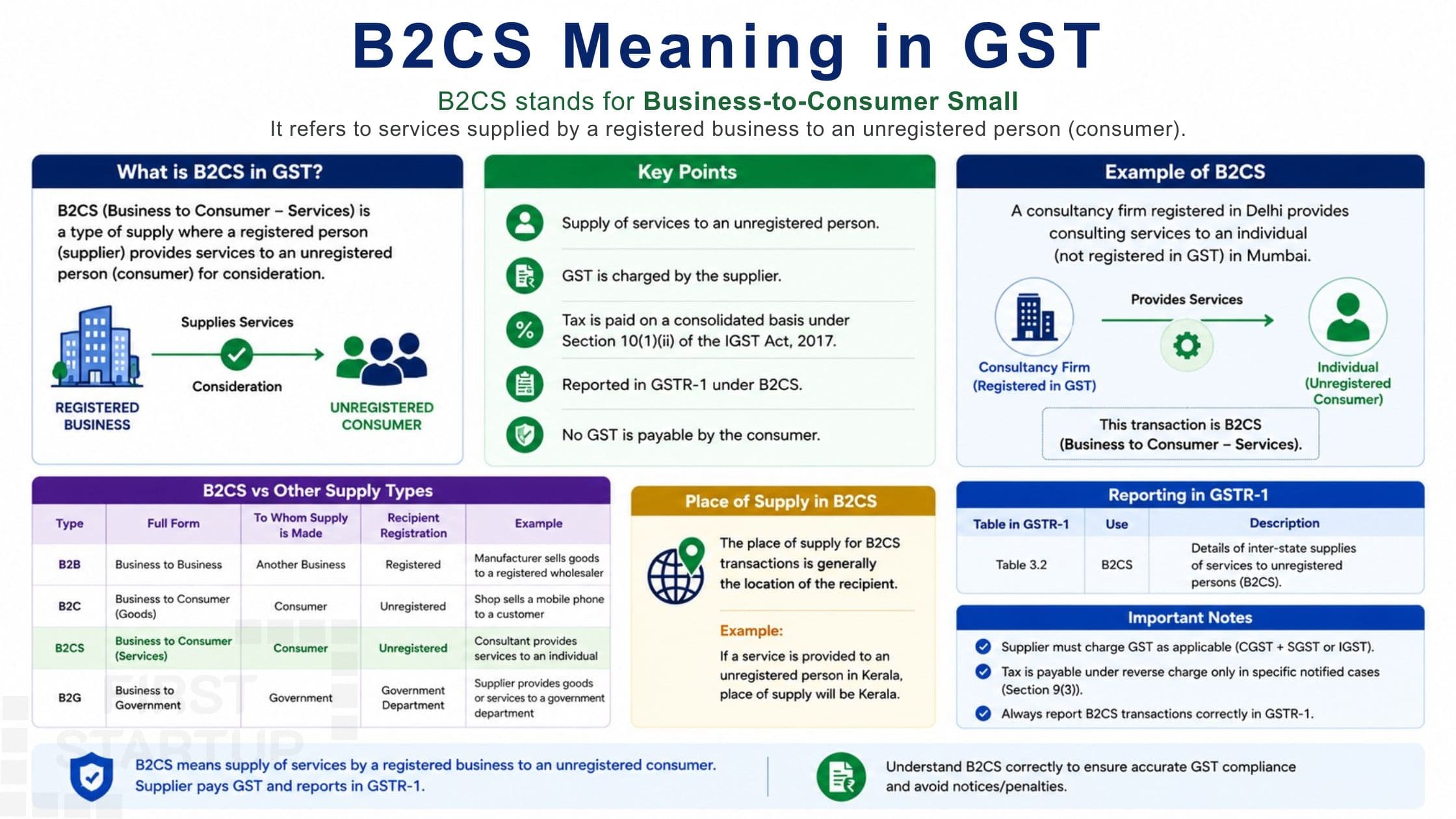
Goods and Services Tax (GST) compliance involves several technical terms that every business owner should understand. One such commonly used term is B2CS (Business-to-Consumer Small). Many taxpayers, especially small businesses and GST filers, often search for the exact B2CS meaning in GST and how it affects GST return filing.
In this detailed guide, we will explain the meaning of B2CS in GST, its applicability, reporting rules, examples, difference between B2B and B2CS, and important compliance requirements for businesses in India.
What is B2CS Meaning in GST?
The term B2CS in GST stands for:
Business to Consumer Small
It refers to sales made by a registered business to unregistered consumers where the invoice value is relatively small.
Under GST, B2CS transactions are reported in GST returns, mainly in GSTR-1.
These transactions generally include:
Retail sales
Direct customer sales
Small-value invoices
Sales to unregistered persons
The B2CS meaning in GST mainly applies when goods or services are sold directly to end consumers who are not registered under GST.
Definition of B2CS Under GST
A transaction is categorized as B2CS when:
The buyer is unregistered under GST
The invoice value is up to ₹2.5 lakh for interstate transactions
Sales are made directly to consumers
No GSTIN of the customer is available
These transactions must be reported separately in GST return filing.
Where is B2CS Reported in GST Returns?
B2CS details are reported in:
GSTR-1 Return
Businesses need to disclose B2CS sales in the appropriate section of GSTR-1.
The return includes:
State-wise sales summary
Tax rate details
Taxable value
CGST, SGST, and IGST amounts
Proper reporting of B2CS in GST helps maintain accurate GST compliance.
Examples of B2CS Transactions
To understand the B2CS meaning in GST, let’s look at some examples.
Example 1: Local Retail Sale
A clothing store in Delhi sells garments worth ₹10,000 to an individual customer who does not have GST registration.
This transaction qualifies as B2CS.
Example 2: Online Sale to Consumer
An online seller ships products worth ₹15,000 to a customer in another state who is not GST registered.
If the invoice value is below ₹2.5 lakh, it falls under B2CS.
Example 3: Restaurant Billing
A restaurant issues bills to walk-in customers without GSTIN details.
These sales are treated as B2CS transactions.
Difference Between B2B and B2CS in GST
Many taxpayers confuse B2B and B2CS transactions.
Here’s the difference:
| Particulars | B2B | B2CS |
|---|---|---|
| Buyer | Registered Dealer | Unregistered Consumer |
| GSTIN Required | Yes | No |
| Invoice Reporting | Invoice-wise | Consolidated Summary |
| Input Tax Credit | Available | Not Available |
| Transaction Nature | Business Sales | Retail Consumer Sales |
Understanding this difference is important for correct GST filing.
B2CS vs B2CL in GST
Another commonly misunderstood term is B2CL.
What is B2CL?
B2CL means:
Business to Consumer Large
These are interstate sales made to unregistered persons where invoice value exceeds ₹2.5 lakh.
Difference Between B2CS and B2CL
| Basis | B2CS | B2CL |
|---|---|---|
| Invoice Value | Up to ₹2.5 Lakh | Above ₹2.5 Lakh |
| Customer | Unregistered | Unregistered |
| Reporting Method | Consolidated | Invoice-wise |
| Interstate Sales | Allowed | Allowed |
Why is B2CS Important in GST?
Understanding B2CS meaning in GST is important because incorrect classification may lead to:
GST notice
Return mismatch
Penalties
Filing errors
Compliance issues
Accurate reporting helps businesses avoid unnecessary tax complications.
How to Report B2CS in GSTR-1?
Follow these steps to report B2CS transactions:
Step 1: Login to GST Portal
Access the GST portal using GST credentials.
Step 2: Open GSTR-1
Select the relevant return period.
Step 3: Choose B2CS Section
Go to the “B2CS – Small Supplies” section.
Step 4: Enter Transaction Details
Provide:
Place of supply
Tax rate
Taxable value
GST amount
Step 5: Verify and Submit
Review details carefully before filing.
Information Required for B2CS Reporting
Businesses should maintain proper records for B2CS transactions.
Required details include:
Invoice amount
Place of supply
GST rate
Taxable value
Nature of goods/services
Maintaining accurate records ensures smooth GST compliance.
Common Mistakes While Reporting B2CS
Many businesses make errors while filing GST returns.
1. Wrong Classification
Incorrectly reporting B2CL transactions under B2CS.
2. Incorrect Tax Rate
Applying wrong GST rates to consumer sales.
3. Missing Interstate Sales
Not reporting interstate B2CS transactions properly.
4. Duplicate Entries
Entering the same transaction multiple times.
Applicability of B2CS for E-Commerce Sellers
E-commerce businesses frequently deal with B2CS transactions because they sell directly to consumers.
Examples include:
Clothing sellers
Electronics stores
Food delivery businesses
Cosmetic brands
Home décor sellers
Such businesses must carefully report B2CS supplies in GST returns.
Is Invoice-wise Reporting Required for B2CS?
Generally, B2CS sales are reported in consolidated form.
Businesses usually do not need invoice-wise reporting for small-value B2CS transactions.
However, accurate tax summaries are mandatory.
Tax Rates Applicable on B2CS Transactions
The GST rate applicable on B2CS depends on the product or service sold.
Common GST rates include:
5%
12%
18%
28%
Businesses must apply the correct rate while reporting B2CS sales.
Benefits of Proper B2CS Reporting
Correct B2CS reporting provides several advantages:
Better GST compliance
Reduced risk of notices
Accurate tax records
Easier return reconciliation
Improved business transparency
Penalty for Incorrect B2CS Filing
Improper filing may result in:
Late fees
Interest liability
GST notices
Return rejection
Compliance penalties
Businesses should regularly review GST data before submission.
Tips for Managing B2CS Transactions
Here are some useful tips:
Maintain Proper Sales Records
Keep invoices and billing records organized.
Use GST Software
Automated accounting tools reduce filing errors.
Verify Tax Rates
Always apply correct GST slabs.
Reconcile Monthly Data
Cross-check sales data before filing GSTR-1.
Frequently Asked Questions (FAQs)What is B2CS meaning in GST?
B2CS means Business to Consumer Small. It refers to small-value sales made to unregistered customers.
What is the invoice limit for B2CS?
For interstate transactions, invoices up to ₹2.5 lakh are treated as B2CS.
Is GSTIN required for B2CS?
No, customers in B2CS transactions are unregistered and do not have GSTIN.
Where is B2CS reported?
B2CS details are reported in GSTR-1 returns.
What is the difference between B2CS and B2CL?
B2CS applies to small-value invoices, while B2CL applies to invoices above ₹2.5 lakh.
Final Words
Understanding the B2CS meaning in GST is essential for every GST-registered business in India. Proper classification and reporting of B2CS transactions help businesses maintain smooth GST compliance and avoid penalties.
Whether you run a retail shop, online store, restaurant, or service business, accurate reporting of B2CS transactions in GSTR-1 is important for maintaining error-free GST records.
Businesses should regularly review their GST filings and maintain proper documentation to ensure complete compliance with GST regulations.